
Monday, January 08, 2007
The Fugitive Countess


Friday, January 05, 2007
Review of Bungay Castle in Dark Realms Magazine
Editor Curt Herr invites readers to rediscover a 200-year-old treasure, as he guides us on an exploration of a lesser-known but no less classic tale of gothic romance and mystery in Bungay Castle. Herr, a teacher of gothic literature, explains in his eloquent introduction that this novel, like the castle for which it was named, was "built to last." Herr points out that author Elizabeth Bonhote's reversal of gender stereotypes concept for an 18th century female writer contemporary feminist roles. Herr also footnotes the text throughout for more academic study of its importance since the novel was first published in 1796. The lovely heroine of Bungay Castle is Roseline, a young woman who seeks more to life than what is expected of her. Accompanied by her brother Edwin, she sets out to investigate ghostly sounds emanating from the castle's ancient dungeons. There they discover a true horror from their family's past tragedy, and despair. A must-read for students and fans of gothic literature, Bungay Castle is a prime example of the subtle unease and suspense of the genre.
Christine Filipak
Dark Realms Magazine
http://www.monolithgraphics.com/darkrealms.html
Monday, November 27, 2006
The End of Gothic Chapbook Reproductions
There is no doubt that these tales of terror, though, are an important aspect of literary history and Zittaw Press is committed to ensuring that these chapbooks are preserved. Consequently we are looking into offering some of the titles as ebooks available for downloading, as well as the possibility of anthologies or collections, but at this time we are looking into all options.
We have appreciated all your support, patronage and insights. Zittaw Press will continue to publish rare 18th and 19th century Gothic fiction and hope to enable scholars and students of the Gothic access to these rare texts.
Best,
Franz and Serena Potter
Zittaw Press
Monday, October 09, 2006
The Abbess Now Available
Wednesday, September 27, 2006
Edith Birkhead's The Tale of Terror
Monday, September 25, 2006
New Titles available
Monday, September 18, 2006
The demise of some bluebooks
 Effective October 31st, the following Gothic chapbook reproductions will NO LONGER BE AVAILABLE:
Albert of Werdendorf; or, The Midnight Embrace
The Bloody Hand; or, The Fatal Cup
Black Forest or the Cavern of Death
The Horrible Revenge
Maid of Lochlin
The Spectres
Chateau de Montville
The Wandering Spirit
Sunday, August 27, 2006
New Chapbooks Now Available
The Horrors of Oakendale Abbey is now at the printers and The Abbess and Rayland Hall are on their way soon.
Read More Gothic!
Tuesday, August 15, 2006
READING THE GOTHIC: The Forgotten Goth

Tuesday, August 01, 2006
READING THE GOTHIC: Blood and Morality
Saturday, July 29, 2006
The Castle Spectre
Tuesday, July 25, 2006
Podcast
Monday, July 17, 2006
READING THE GOTHIC: Adapting Horror
 popularity of the Gothic novel. From Horace Walpole’s The Castle of Otranto to Stephen King’s Cell, from James Whale’s Frankenstein to Eli Roth’s The Hostel, the Gothic continues to permeate fiction and film today. Why though? Its not as if the giant helmet that crushed the poor Conrad could illicit more than laughter from today’s readers, and it’s hard to imagine an eighteenth century reader understanding the Zombie effects of a cell phone in Stephen King’s dark wasteland. So how does the Gothic continue to hold its deathlike grip on us? Simple, it adapts, finding what the modern reader finds most horrific and holds it up to the light for us to see.
Thursday, July 13, 2006
New German Gothic Series
The other titles will include:
Peter Will: The Victim of Magical Delusion (1795); from the German of Cajetan Tschink.
Joseph Trapp: The Genius; or, the Mysterious adventures of Don Carlos de Grandez (1796) from the German of Carl Grosse.
Anon.: Hermann of Unna (1794); from the German of Christiane Benedicte Eugenie Naubert.
Matthew Gregory Lewis: Feudal Tyrants (1806); from the German of Christiane Benedicte Eugenie Naubert.
John Hinckley: The History of Rinaldo Rinaldini; Captain of Banditti (1800); from the German of Christian August Vulpius.
D. Boileau: The Ghost-seer (1795); from the German of Friedrich von Schiller.
Robert Pierce Gillies: The Devil's Elixir (1824); from the German of Ernst Theodor Amadeus Hofmann.
Three Gothic Novels from the German of Veit Weber (i.e. Leonhard Waechter)
Robert Huish: The Sorcerer
Anon.: The Black Valley
James Powell: Wolf; or, The Tribunal of Blood
Anon.: The Dwarf of Westerbourg (1827); from the German of Christian Heinrich Spiess.
A special thanks must go out to Norbert Besch for all his assistance in this forthcoming series as well as contributing to Zittaw Press as a whole. Through his diligent efforts, Zittaw Press has been able to obtain many of the texts republished thus far, and his guidance in this new series is greatly appreciated.
Monday, July 10, 2006
New Gothic titles
READING THE GOTHIC: Garish Supernatual Horrors of The Abbess
Tuesday, July 04, 2006
READING THE GOTHIC: Romances and Gothic Tales
Monday, June 26, 2006
READING THE GOTHIC: An overview of Zittaw Press
Saturday, June 24, 2006
The Gothic Graphic Novel
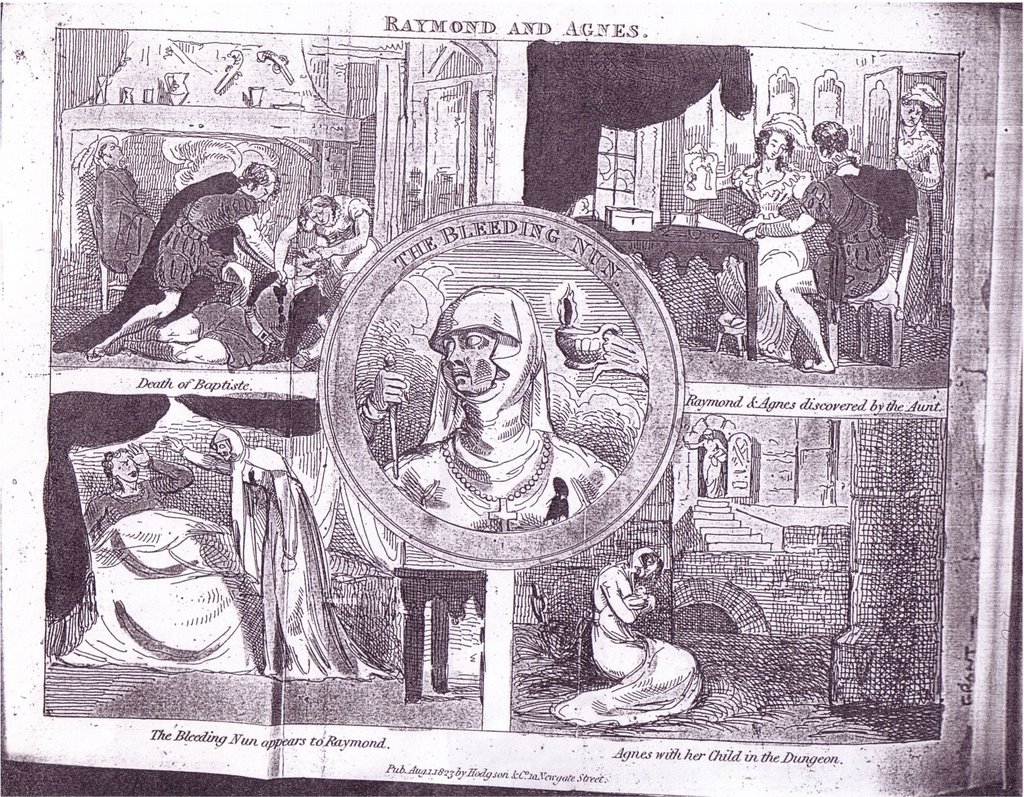
Zittaw Press is pleased to announce a new series of Gothic graphic novels to compliment our chapbook reproductions and rare novel reprints beginning next year. The series will feature graphic adaptations of Gothic chapbooks as well as full length novels based on well-known Gothic novels such as The Monk. The concept of a Gothic graphic novel, of course, is not new as there are multiple 'gothic' publications available including Richard Moore’s Boneyard,Roman Dirge’s Lenore and Butch Adams’ Lily – When I Was Dead, but none based on original 18th and 19th century Gothic fiction. However, the idea of illustrating Gothic chapbooks or even novels is not new as this illustration from the chapbook Raymond and Agnes underscores. Simply laid out in an extra large fold out illustration the artist captured several of the most important scenes from the chapbooks and provided the reader with an intimate glance at the characters. Novels, like chapbooks, often contained a frontpiece illustration and latter editions, I am particularly thinking about The Mysteries of Udolpho, contained several illustrated scenes from the novel. Fundamentally, at Zittaw Press we see the adaptability of the Gothic, the way it changes with time. While our main interest in reprinting the Gothic is to allow students, scholars and general readers access to these rare novels, we also want to allow a large audience to participate in discovering the genre and, perhaps, realizing how much the Gothic has influenced modern literature.
Monday, June 19, 2006
Podcast: READING THE GOTHIC
Zittaw Press is now starting a weekly podcast, READING THE GOTHIC, previewing forthcoming titles, spotlighting authors and editors, discussing Gothic novels in the classroom, looking at contemporary Gothic trends and everything and anything Gothic.
Our first attempt, A Preview of The Horrors of Oakendale Abbey, is available here: http://www.zittaw.com/readings1.mp3
Please be kind as we are just learning what to do.
