
Monday, October 09, 2006
The Abbess Now Available
William Henry Ireland's The Abbess is now available at Amazon.com and Barnes and Noble.com. Enjoy the Gothic!


Wednesday, September 27, 2006
Edith Birkhead's The Tale of Terror
Zittaw Press is pleased to announce that a new edition of Edith Birkhead's The Tale of Terror: A Study of the Gothic Romance will be published in spring 2007. With an updated introduction and notes, Birkhead's 1921 groundbeaking study will be available to all readers of the Gothic.
Monday, September 25, 2006
New Titles available
The Horrors of Oakendale Abbey and Rayland Hall are both now available at online booksellers. Get them while they are hot and start enjoying the holloween buildup.
Monday, September 18, 2006
The demise of some bluebooks
 Effective October 31st, the following Gothic chapbook reproductions will NO LONGER BE AVAILABLE:
Albert of Werdendorf; or, The Midnight Embrace
The Bloody Hand; or, The Fatal Cup
Black Forest or the Cavern of Death
The Horrible Revenge
Maid of Lochlin
The Spectres
Chateau de Montville
The Wandering Spirit
Sunday, August 27, 2006
New Chapbooks Now Available
The following chapbooks are now available: The Mysterious Bottle of Old Hock (1825), Saint Anthony's Flask; or, The Devil's Wine! (1830) and Sarah Wilkinson's The Castle Spectre: An Ancient Baronial Romance (1820) Also now available are two Gothic dramas: Matthew Lewis's The Castle Spectre (1798) and Edward Fitzball's The Devil's Elixir (1829).
The Horrors of Oakendale Abbey is now at the printers and The Abbess and Rayland Hall are on their way soon.
Read More Gothic!
The Horrors of Oakendale Abbey is now at the printers and The Abbess and Rayland Hall are on their way soon.
Read More Gothic!
Tuesday, August 15, 2006
READING THE GOTHIC: The Forgotten Goth

Tuesday, August 01, 2006
READING THE GOTHIC: Blood and Morality
Saturday, July 29, 2006
The Castle Spectre
Zittaw Press is pleased to announce a new series of reproductions beginning August 7th: Gothic Dramas. The Series will commence with the release of Matthew Lewis's drama The Castle Spectre which will be released together with the Sarah Wilkinson's chapbook adaptation of The Castle Spectre. Other forthcoming titles include the drama The Devil's Elixir; or, The Shadowless Man which will be released with the chapbook Saint Anthony's Flask, Edward Fitz-Ball's The Flying Dutchman; or, The Phantom Ship and Matthew Lewis's One O'Clock; or, The Knight of the Wood Demon. All titles will only be available through our website at www.zittaw.com.
Tuesday, July 25, 2006
Podcast
This week's podcast will be slightly delayed as I am out of town. We are enjoying the great response from these casts and appreciate your feedback. Read more Gothic.
Monday, July 17, 2006
READING THE GOTHIC: Adapting Horror
 popularity of the Gothic novel. From Horace Walpole’s The Castle of Otranto to Stephen King’s Cell, from James Whale’s Frankenstein to Eli Roth’s The Hostel, the Gothic continues to permeate fiction and film today. Why though? Its not as if the giant helmet that crushed the poor Conrad could illicit more than laughter from today’s readers, and it’s hard to imagine an eighteenth century reader understanding the Zombie effects of a cell phone in Stephen King’s dark wasteland. So how does the Gothic continue to hold its deathlike grip on us? Simple, it adapts, finding what the modern reader finds most horrific and holds it up to the light for us to see.
Thursday, July 13, 2006
New German Gothic Series
Zittaw Press is proud to announce the launch of a new series of Ten German Gothic novels that have shaped and influenced their English counterparts. This unique series, under the direction of Norbert Besch and Franz Potter, will begin in 2007 with Matthew Lewis's The Bravo of Venice (1805); from the German of Johann Heinrich Daniel Zschokke.
The other titles will include:
Peter Will: The Victim of Magical Delusion (1795); from the German of Cajetan Tschink.
Joseph Trapp: The Genius; or, the Mysterious adventures of Don Carlos de Grandez (1796) from the German of Carl Grosse.
Anon.: Hermann of Unna (1794); from the German of Christiane Benedicte Eugenie Naubert.
Matthew Gregory Lewis: Feudal Tyrants (1806); from the German of Christiane Benedicte Eugenie Naubert.
John Hinckley: The History of Rinaldo Rinaldini; Captain of Banditti (1800); from the German of Christian August Vulpius.
D. Boileau: The Ghost-seer (1795); from the German of Friedrich von Schiller.
Robert Pierce Gillies: The Devil's Elixir (1824); from the German of Ernst Theodor Amadeus Hofmann.
Three Gothic Novels from the German of Veit Weber (i.e. Leonhard Waechter)
Robert Huish: The Sorcerer
Anon.: The Black Valley
James Powell: Wolf; or, The Tribunal of Blood
Anon.: The Dwarf of Westerbourg (1827); from the German of Christian Heinrich Spiess.
A special thanks must go out to Norbert Besch for all his assistance in this forthcoming series as well as contributing to Zittaw Press as a whole. Through his diligent efforts, Zittaw Press has been able to obtain many of the texts republished thus far, and his guidance in this new series is greatly appreciated.
The other titles will include:
Peter Will: The Victim of Magical Delusion (1795); from the German of Cajetan Tschink.
Joseph Trapp: The Genius; or, the Mysterious adventures of Don Carlos de Grandez (1796) from the German of Carl Grosse.
Anon.: Hermann of Unna (1794); from the German of Christiane Benedicte Eugenie Naubert.
Matthew Gregory Lewis: Feudal Tyrants (1806); from the German of Christiane Benedicte Eugenie Naubert.
John Hinckley: The History of Rinaldo Rinaldini; Captain of Banditti (1800); from the German of Christian August Vulpius.
D. Boileau: The Ghost-seer (1795); from the German of Friedrich von Schiller.
Robert Pierce Gillies: The Devil's Elixir (1824); from the German of Ernst Theodor Amadeus Hofmann.
Three Gothic Novels from the German of Veit Weber (i.e. Leonhard Waechter)
Robert Huish: The Sorcerer
Anon.: The Black Valley
James Powell: Wolf; or, The Tribunal of Blood
Anon.: The Dwarf of Westerbourg (1827); from the German of Christian Heinrich Spiess.
A special thanks must go out to Norbert Besch for all his assistance in this forthcoming series as well as contributing to Zittaw Press as a whole. Through his diligent efforts, Zittaw Press has been able to obtain many of the texts republished thus far, and his guidance in this new series is greatly appreciated.
Monday, July 10, 2006
New Gothic titles
Its wonderful to see the resurrection of the Gothic proceed with such speed suddenly. For years we have been confined to only a small number of non-canonical titles available and now there seems to be new titles finding their way to bookshelves and libraries. Its about time. We have recently added four new titles to our forthcoming list for 2007 including George Moore's Grasville Abbey, Jane Austen's Northanger Abbey, Richard Warner's Netley Abbey and Matthew Lewis's The Bravo of Venice which we hope will add to the further study of the Gothic. As usual, if you have any suggestions or projects you would like to suggest, please drop me an email.
READING THE GOTHIC: Garish Supernatual Horrors of The Abbess
Tuesday, July 04, 2006
READING THE GOTHIC: Romances and Gothic Tales
Monday, June 26, 2006
READING THE GOTHIC: An overview of Zittaw Press
Saturday, June 24, 2006
The Gothic Graphic Novel
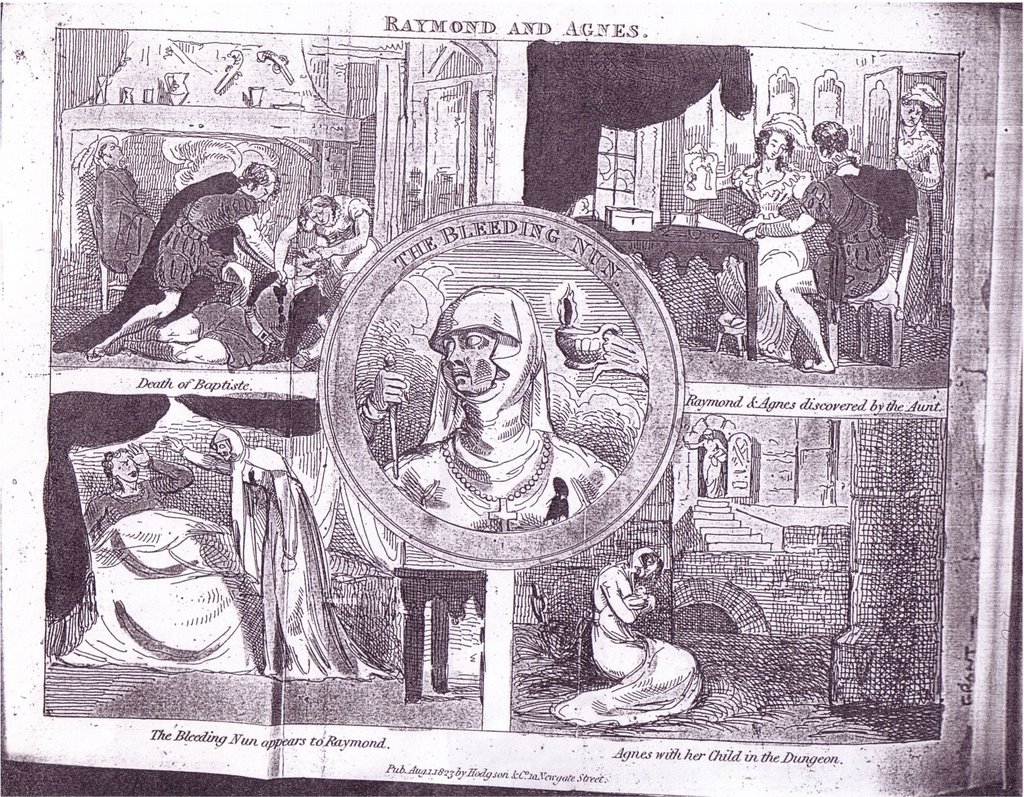
Zittaw Press is pleased to announce a new series of Gothic graphic novels to compliment our chapbook reproductions and rare novel reprints beginning next year. The series will feature graphic adaptations of Gothic chapbooks as well as full length novels based on well-known Gothic novels such as The Monk. The concept of a Gothic graphic novel, of course, is not new as there are multiple 'gothic' publications available including Richard Moore’s Boneyard,Roman Dirge’s Lenore and Butch Adams’ Lily – When I Was Dead, but none based on original 18th and 19th century Gothic fiction. However, the idea of illustrating Gothic chapbooks or even novels is not new as this illustration from the chapbook Raymond and Agnes underscores. Simply laid out in an extra large fold out illustration the artist captured several of the most important scenes from the chapbooks and provided the reader with an intimate glance at the characters. Novels, like chapbooks, often contained a frontpiece illustration and latter editions, I am particularly thinking about The Mysteries of Udolpho, contained several illustrated scenes from the novel. Fundamentally, at Zittaw Press we see the adaptability of the Gothic, the way it changes with time. While our main interest in reprinting the Gothic is to allow students, scholars and general readers access to these rare novels, we also want to allow a large audience to participate in discovering the genre and, perhaps, realizing how much the Gothic has influenced modern literature.
Monday, June 19, 2006
Podcast: READING THE GOTHIC
Zittaw Press is now starting a weekly podcast, READING THE GOTHIC, previewing forthcoming titles, spotlighting authors and editors, discussing Gothic novels in the classroom, looking at contemporary Gothic trends and everything and anything Gothic.
Our first attempt, A Preview of The Horrors of Oakendale Abbey, is available here: http://www.zittaw.com/readings1.mp3
Please be kind as we are just learning what to do.
Tuesday, June 13, 2006
Teaching the Gothic
It is staggering to think about the growing number of resources those of us who teach the Gothic now have available for our students. Between Zittaw and Valancourt numerous rare texts are now at our finger tips. I started Zittaw Press with the simple goal of making these rare available to students and scholars alike, but now that I am teaching graduate courses on the Gothic though, I am faced with the daunting question of what Gothic novels to utilize in the classroom. The choice is fundamentally between the canonical and the trade, between Radcliffe and Lewis and the mirad of newly published minor (albeit important) novels. So far I have opted for the middle ground with a careful blend of the canonical and the minor (including bluebooks) in an effort to give the students a balanced overview of the genre. Students have overall really enjoyed both Radcliffe and Lewis. The Monk has generally been the favourite with all the sensationalism and horror, not to mention the sex; Radcliffe is equally enjoyed, but the sex usually intrigues the students more. Chosing the right minor novel has been more difficult. Last year I taught two courses on the Gothic and used William Henry Ireland's Gondez the Monk each semester, but with two very different reactions. The first semester I had the students read Radcliffe, Lewis and then Ireland followed by bluebooks and short Gothic tales. The students generally loved both Radcliffe and Lewis, but when it came to Gondez they found the language difficult and the inset tales too labourious. They liked the novel, but could understand why it was considered a minor text. The bluebook and short tales of terror they thoroughly loved, but they were continually haunted by the difficulty of Gondez, which I admit surprised me. The second semester I taught the same novels, but changed the order. I taught short tales of terror and bluebooks first, Gondez second, followed by Lewis and Radcliffe, the simple change was amazing. The short tale and bluebooks were extremely popular as usual, so I was looking forward to Gondez with renewed hope in my students. I was not disappointed in my hopes. The students did in fact immensely enjoy Gondez. They found the historical note intriguing, the sexual politics engaging, it was a hit this time. They likewise found Lewis and Radcliffe fascinating and accessible. They were not haunted by Gondez, but found that it was a stepping stone from the short tales of terror to the canonical. I think I will try some new minor texts this coming semester, but as the list of forgotten Gothic grows the choice is becoming more difficult.
If anyone has any suggestions, I would love to hear them.
If anyone has any suggestions, I would love to hear them.
Thursday, June 08, 2006
Isaac Crookenden/chapbooks
I recently obtained a copy of Isaac Crookenden's The Horrible Revenge; or, The Monster of Italy which we plan to publish sometime this fall. It is an interesting tale and a wonderful example of how chapbookers utilised various plots from bestselling Gothic novels to create a sensational tale. Crookenden blends the plots of The Monk, The Demon of Sicily and The Mysteries of Udolpho into a cesspool of incest, depravity and filth, strangely attractive to 19th century readers as it is to modern readers.
Isaac Crookenden, along with Sarah Wilkinson, was a major producer of Gothic tales of terror. Nothing is really known about this author, or if that was even his name. He wrote numerous chapbooks including Fatal Secrets; or, Etherlinda de Salmoni, The Italian Banditti; or, The Secret History of Henry and Matilda, The Spectre of the Turret; or, Guolto Castle, The Skeleton; or, the Mysterious Discovery and The Mysterious Murder; or, The Usurper of Naples. His style though is distinctly different from Wilkinson. Where Wilkinson seeks to blend the supernatural with the didactic seamlessly, Crookenden enjoys piling supernatual terrors upon subterranean horrors, the erotic with the religious. The end though is the same, tales of terrors that excite and thrill the reader.
Isaac Crookenden, along with Sarah Wilkinson, was a major producer of Gothic tales of terror. Nothing is really known about this author, or if that was even his name. He wrote numerous chapbooks including Fatal Secrets; or, Etherlinda de Salmoni, The Italian Banditti; or, The Secret History of Henry and Matilda, The Spectre of the Turret; or, Guolto Castle, The Skeleton; or, the Mysterious Discovery and The Mysterious Murder; or, The Usurper of Naples. His style though is distinctly different from Wilkinson. Where Wilkinson seeks to blend the supernatural with the didactic seamlessly, Crookenden enjoys piling supernatual terrors upon subterranean horrors, the erotic with the religious. The end though is the same, tales of terrors that excite and thrill the reader.
Sunday, June 04, 2006
Gothic Mysteries

I have been reading the letters of Sarah Wilkinson to the Royal Literary Fund with a mind to The Spectre of Lanmere Abbey. There are some fascinating mysteries that surround her life and I am determined to solve them. Literature, moreover, the Gothic, is full of mysteries. The author's lives are certainly intriguing and Wilkinson's is no different. Indeed, most of Wilkinson's works were autobiographical and therein lies some of the mysteries, what is real and what is an illusion. Perhaps it is the mysteries that surround the Gothic which make it still important.
Subscribe to:
Posts (Atom)
