

Tuesday, July 04, 2006
READING THE GOTHIC: Romances and Gothic Tales


Monday, June 26, 2006
READING THE GOTHIC: An overview of Zittaw Press
Saturday, June 24, 2006
The Gothic Graphic Novel
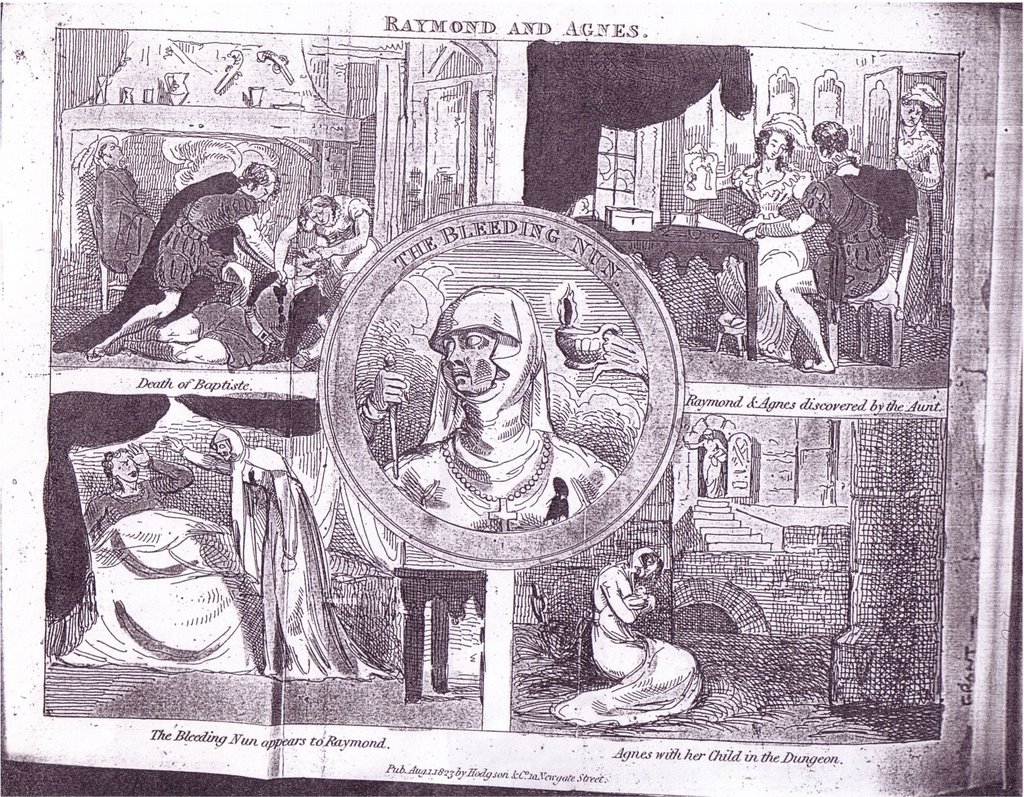
Zittaw Press is pleased to announce a new series of Gothic graphic novels to compliment our chapbook reproductions and rare novel reprints beginning next year. The series will feature graphic adaptations of Gothic chapbooks as well as full length novels based on well-known Gothic novels such as The Monk. The concept of a Gothic graphic novel, of course, is not new as there are multiple 'gothic' publications available including Richard Moore’s Boneyard,Roman Dirge’s Lenore and Butch Adams’ Lily – When I Was Dead, but none based on original 18th and 19th century Gothic fiction. However, the idea of illustrating Gothic chapbooks or even novels is not new as this illustration from the chapbook Raymond and Agnes underscores. Simply laid out in an extra large fold out illustration the artist captured several of the most important scenes from the chapbooks and provided the reader with an intimate glance at the characters. Novels, like chapbooks, often contained a frontpiece illustration and latter editions, I am particularly thinking about The Mysteries of Udolpho, contained several illustrated scenes from the novel. Fundamentally, at Zittaw Press we see the adaptability of the Gothic, the way it changes with time. While our main interest in reprinting the Gothic is to allow students, scholars and general readers access to these rare novels, we also want to allow a large audience to participate in discovering the genre and, perhaps, realizing how much the Gothic has influenced modern literature.
Monday, June 19, 2006
Podcast: READING THE GOTHIC
Zittaw Press is now starting a weekly podcast, READING THE GOTHIC, previewing forthcoming titles, spotlighting authors and editors, discussing Gothic novels in the classroom, looking at contemporary Gothic trends and everything and anything Gothic.
Our first attempt, A Preview of The Horrors of Oakendale Abbey, is available here: http://www.zittaw.com/readings1.mp3
Please be kind as we are just learning what to do.
Tuesday, June 13, 2006
Teaching the Gothic
It is staggering to think about the growing number of resources those of us who teach the Gothic now have available for our students. Between Zittaw and Valancourt numerous rare texts are now at our finger tips. I started Zittaw Press with the simple goal of making these rare available to students and scholars alike, but now that I am teaching graduate courses on the Gothic though, I am faced with the daunting question of what Gothic novels to utilize in the classroom. The choice is fundamentally between the canonical and the trade, between Radcliffe and Lewis and the mirad of newly published minor (albeit important) novels. So far I have opted for the middle ground with a careful blend of the canonical and the minor (including bluebooks) in an effort to give the students a balanced overview of the genre. Students have overall really enjoyed both Radcliffe and Lewis. The Monk has generally been the favourite with all the sensationalism and horror, not to mention the sex; Radcliffe is equally enjoyed, but the sex usually intrigues the students more. Chosing the right minor novel has been more difficult. Last year I taught two courses on the Gothic and used William Henry Ireland's Gondez the Monk each semester, but with two very different reactions. The first semester I had the students read Radcliffe, Lewis and then Ireland followed by bluebooks and short Gothic tales. The students generally loved both Radcliffe and Lewis, but when it came to Gondez they found the language difficult and the inset tales too labourious. They liked the novel, but could understand why it was considered a minor text. The bluebook and short tales of terror they thoroughly loved, but they were continually haunted by the difficulty of Gondez, which I admit surprised me. The second semester I taught the same novels, but changed the order. I taught short tales of terror and bluebooks first, Gondez second, followed by Lewis and Radcliffe, the simple change was amazing. The short tale and bluebooks were extremely popular as usual, so I was looking forward to Gondez with renewed hope in my students. I was not disappointed in my hopes. The students did in fact immensely enjoy Gondez. They found the historical note intriguing, the sexual politics engaging, it was a hit this time. They likewise found Lewis and Radcliffe fascinating and accessible. They were not haunted by Gondez, but found that it was a stepping stone from the short tales of terror to the canonical. I think I will try some new minor texts this coming semester, but as the list of forgotten Gothic grows the choice is becoming more difficult.
If anyone has any suggestions, I would love to hear them.
If anyone has any suggestions, I would love to hear them.
Thursday, June 08, 2006
Isaac Crookenden/chapbooks
I recently obtained a copy of Isaac Crookenden's The Horrible Revenge; or, The Monster of Italy which we plan to publish sometime this fall. It is an interesting tale and a wonderful example of how chapbookers utilised various plots from bestselling Gothic novels to create a sensational tale. Crookenden blends the plots of The Monk, The Demon of Sicily and The Mysteries of Udolpho into a cesspool of incest, depravity and filth, strangely attractive to 19th century readers as it is to modern readers.
Isaac Crookenden, along with Sarah Wilkinson, was a major producer of Gothic tales of terror. Nothing is really known about this author, or if that was even his name. He wrote numerous chapbooks including Fatal Secrets; or, Etherlinda de Salmoni, The Italian Banditti; or, The Secret History of Henry and Matilda, The Spectre of the Turret; or, Guolto Castle, The Skeleton; or, the Mysterious Discovery and The Mysterious Murder; or, The Usurper of Naples. His style though is distinctly different from Wilkinson. Where Wilkinson seeks to blend the supernatural with the didactic seamlessly, Crookenden enjoys piling supernatual terrors upon subterranean horrors, the erotic with the religious. The end though is the same, tales of terrors that excite and thrill the reader.
Isaac Crookenden, along with Sarah Wilkinson, was a major producer of Gothic tales of terror. Nothing is really known about this author, or if that was even his name. He wrote numerous chapbooks including Fatal Secrets; or, Etherlinda de Salmoni, The Italian Banditti; or, The Secret History of Henry and Matilda, The Spectre of the Turret; or, Guolto Castle, The Skeleton; or, the Mysterious Discovery and The Mysterious Murder; or, The Usurper of Naples. His style though is distinctly different from Wilkinson. Where Wilkinson seeks to blend the supernatural with the didactic seamlessly, Crookenden enjoys piling supernatual terrors upon subterranean horrors, the erotic with the religious. The end though is the same, tales of terrors that excite and thrill the reader.
Sunday, June 04, 2006
Gothic Mysteries

I have been reading the letters of Sarah Wilkinson to the Royal Literary Fund with a mind to The Spectre of Lanmere Abbey. There are some fascinating mysteries that surround her life and I am determined to solve them. Literature, moreover, the Gothic, is full of mysteries. The author's lives are certainly intriguing and Wilkinson's is no different. Indeed, most of Wilkinson's works were autobiographical and therein lies some of the mysteries, what is real and what is an illusion. Perhaps it is the mysteries that surround the Gothic which make it still important.
Thursday, June 01, 2006
Spectre of Lanmere Abbey
I recently obtained a copy of Sarah Wilkinson's 1820 novel The Spectre of Lanmere Abbey; or, The Mystery of the Blue and White Bag; A Romance which Zittaw Press plans to publish. I first read the novel as I sat in the Rare Books reading room in the British Library several years ago. There was something amazing turning the yellowed paper and soaking in the simple, almost autobiographical nature of the novel. I only had two days to read it and take copious notes before returning to Norwich, but those hours are literally etched upon my memory. Why? It's not that the narrative is innovative, the prose magical, it is more, it was actually alive for me, the scenes that Wilkinson describes, the dirty streets of London, the lush Welsh countryside, the small school room. I had just finished researching Wilkinson's life. I had literally troved the archives and streets of London looking for clues to her mysterious life. I traced where she lived, where she was born and of course where she died. I was shocked to discover that every phyisical location of Wilkinson's life was gone, destroyed by war or progress. Wilkinson lived most of her life in Westminster London, down the street from the archives I searched was her circulating library, now a Victorian building. Several of the boarding houses she lived in are not large blocks of flats, the church where she was buried, destroyed in the war, the workhouse she died in, gone. All physical reminders of her life were gone, except the book that I held in my hands those two days, her legacy, if you could call it that, rested in unread, unresearched books. In the Rare Books room I remember making a vow, probably under my breath, that I would make sure she was remembered, that atleast her books, nearly 200 years after her death would live on. Cheesy as it may be, I will keep that vow. Zittaw Press will publish Lanmere Abbey and other novels as we have done with just a few of her chapbooks. She does need to be remembered, if not for her literary skills, for the hard work of being a female novelist and living by the pen.
Tuesday, May 30, 2006
The Baron's Daughter

I have been working on the Zittaw website for the last few days. The semester has ended and I have two uninterupted months to devote to my own research and catching up with Zittaw material, so I finally turned my attention to updating the site. We also now have a preliminary cover for Isabella Kelly's The Baron's Daughter, but continue tweaking the edges. Covers, as I indicated in my last entry are so important, we do judge the content by them. I decided that the cover of this particular 19th century novel should be modern in its appearance rather than a painting, etching or such. The book really demands it as the characters are rather timeless in their behaviour and thoughts and why shouldn't we see these characters as everybodies, as the girl next door, the guy down the street, the people we see, but cannot be? The Gothic is really timeless, the fears they generate, the social norms they challenge, the questions they raise. Our last title, Bungay Castle by Elizabeth Bonhote is the perfect example of this balance. The heroes and heroine are typical teenagers, fighting the authority of their parents, looking for love, disappointed in love, finding adventure, and discovering their sexual awareness. These issues defy classification to one literary genre or another, they really tell the story of ourselves and it is precisely that point that makes them interesting.
Anyhow, I am including the new cover, if you have a response, let me know, its just an idea.
Sunday, May 28, 2006
Pulp Covers
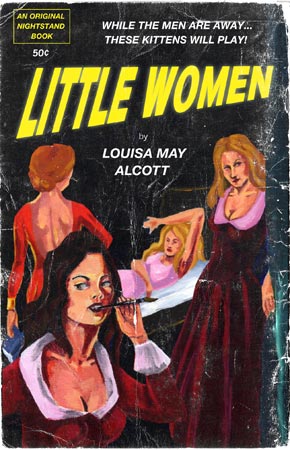
I just read the most interesting article on Slate.com Pulp the Classics about pulp covers for classic literature. What a fantastic idea! The pulp and the Gothic, of course, are the perfect bedfellows. Lurid, sexual, garish and over-the-top, these 1950's covers still speak volumes about the modern reader. They highlight the sensual and the violent, the aspects most pleasing to readers looking for sensationalism rather than substance. This, of course, relates prefectly to the Gothic. Readers of the Gothic were likewise unsophisicated looking for the sensational and the horrific as well as the moralistic and didactic.
Perhaps Zittaw Press should think about the pulp as it republishes the Gothic. What does the modern readers want from the old Gothic novels? The lurid? The sexual? What does this tell us about readers two hundred years ago? What does this tell us about ourselves?
Subscribe to:
Posts (Atom)
